Does Home Air Conditioning Need a Condensate Pump?
A wall-mounted home air conditioner does not automatically need a condensate pump. If its cooling condensate can follow a suitable downward drain route, gravity may be enough. A pump becomes an option when the proposed route needs to rise or cannot provide the required fall. Ask the surveyor to explain the complete water route before accepting either arrangement.
This matters when comparing quotes: a pump can preserve a preferred unit position or reduce visible pipework, but it adds equipment whose sound, maintenance access and fault response need consideration. “Pump included” is only the start of the specification.
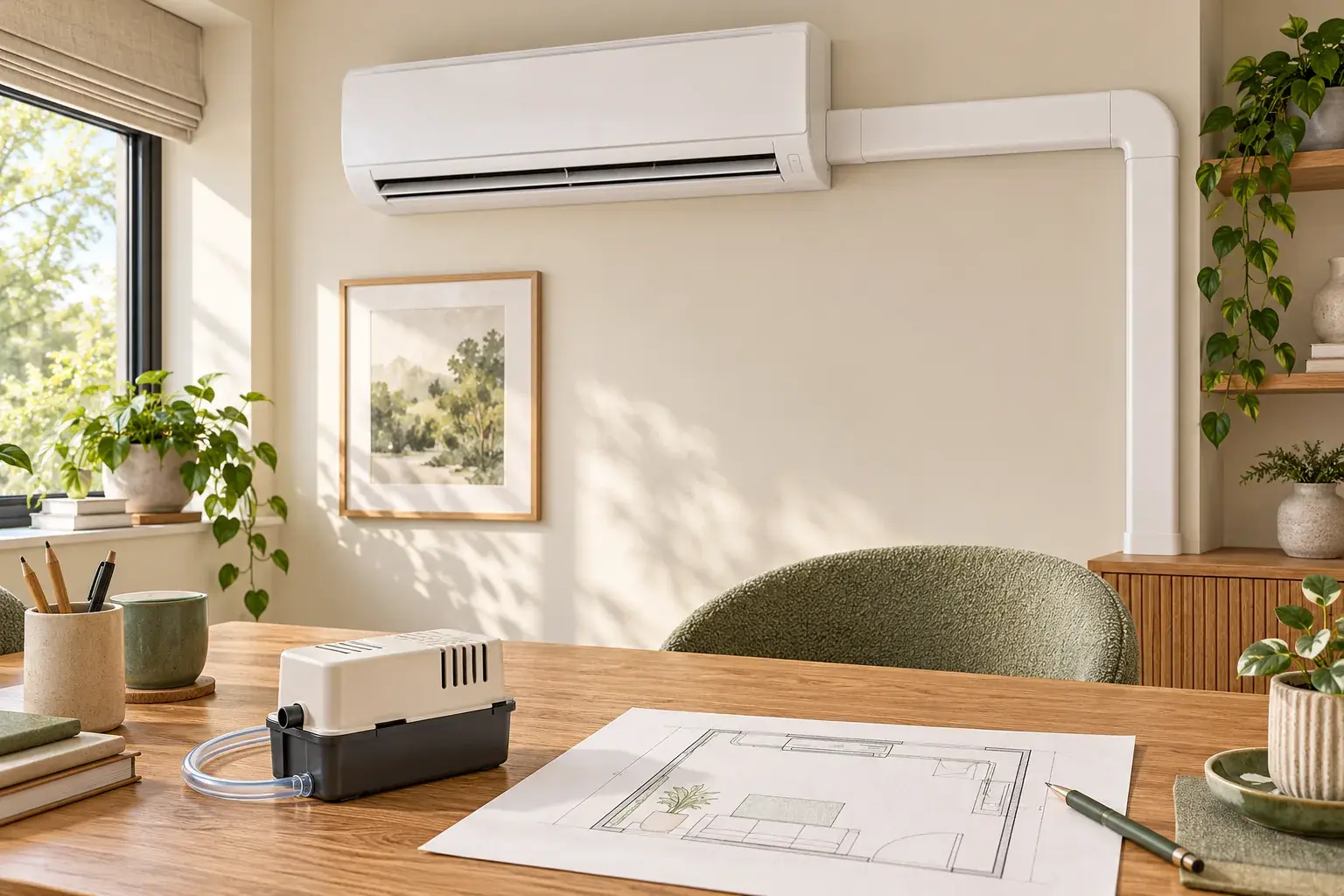
The feature image is an AI-generated editorial concept. The loose pump and sketch illustrate survey planning; they are not a completed customer installation or a technical layout.
First, ask for a separate drainage route
During cooling, moisture removed from the room air collects as water in the indoor unit's drain tray. It needs somewhere to go. The condensate drain is a different part of the installation from the refrigerant pipes connecting the indoor and outdoor units.
Ask the installer to draw the water route from the indoor tray to its proposed discharge point. A refrigerant pipe run through the loft does not, by itself, explain how water will get there.
For example, Daikin's CTXM-A/FTXM-A/ATXM-A installer guide, section 6.4, requires the drain hose to slope downwards and specifies insulation for drainage inside the building. Those details are model-specific instructions for an installer, rather than a universal DIY recipe.
For your proposal, settle three points: where the water starts, whether it ever has to rise, and where it ends. If one is missing, the drainage design is not yet clear enough to compare.
Gravity or pump: what are you agreeing to?
| Decision | Gravity drainage | Pumped drainage |
|---|---|---|
| Why choose it? | A suitable falling route is available | Water needs lifting, or an acceptable falling route cannot be provided |
| Appearance | May involve visible trunking or a different wall position | May allow another route, but ask what covering and access remain visible |
| Sound | No condensate pump motor to hear | Pump operation must be considered separately from the indoor fan |
| Future access | Drain connections still need to be inspectable | Pump, reservoir/sensor and connections also need an access plan |
| Quote detail | Route, termination and finishing | Those items plus pump model, location, protection and maintenance arrangements |
A gravity route is worth exploring because it removes the need for a separate pump. It does not eliminate drainage maintenance or make leaks impossible. Equally, a pump is not evidence of a poor installation: it can be a sensible response to a difficult layout.
If moving the unit is suggested, assess the effect on comfort as well as drainage. Our bedroom position guide considers airflow around the bed; a simpler drain should not be the only reason for choosing a wall.
Four details to settle when a pump is proposed
1. Performance at your actual route
Ask for the pump model and confirmation that it suits the unit's condensate production, lift and hose run. Maximum flow and maximum lifting height should not be treated as though both apply together.
As a product-specific example, the Sauermann Si-30 data sheet lists a maximum flow of 20 litres/hour, but 4 litres/hour at a 10-metre discharge head. Its table also varies flow with suction height and hose length. This is an explanation of how to read a specification, not a recommendation for that pump or a prediction of how much water your home will produce.
2. Sound where you will use the room
Discuss the pump's position and operating sound separately from the air conditioner's quiet fan setting. Aspen's Mini Lime instructions warn that intermittent operation can remain noticeable in very quiet spaces and call for acceptable noise to be confirmed in sensitive rooms.
Tell the surveyor whether the room is used for sleeping, video calls or quiet work. A description such as “quiet pump” should lead to a discussion of the actual installation, rather than an assumption that you will never hear it.
3. What happens if the water level rises?
Ask what protection is provided and how it is connected. The Aspen manual describes a high-water safety connection that can stop the air conditioner or raise an alarm when correctly wired. A supplied switch does not prove that protection is active.
Have the installer explain the intended response and include its test in commissioning. Do not request or attempt a bypass if the system shuts down: an engineer should establish the cause.
4. How it can be serviced after decorating
Agree which cover or panel opens and what needs moving to reach the pump and reservoir. Aspen specifies regular inspection and cleaning of its sensor and filter. That is difficult to arrange if the equipment is permanently boxed behind newly finished joinery.
Ask for the model's maintenance requirements and who will carry them out. Our home air-conditioning servicing guide covers the wider aftercare plan.
Compare two quotes with this drainage card
Illustrative example: a homeowner wants a wall unit in a home office. One proposal uses a gravity drain inside visible trunking along a wall. The other takes drainage upwards into the loft using a pump. Neither proposal is a real customer job or automatically the better choice.
Copy these fields into an email and ask both installers to complete them:
- Indoor position and outlet: Where will the unit sit, and where will its condensate finish?
- Route: Show every section, including any rise, wall entry and visible covering.
- Alternative considered: Could gravity work with another route or unit position? What would that change?
- Pump specification, if needed: Model, location and confirmation of suitability for the proposed lift and run.
- Fault response: What happens if drainage cannot keep up, and how will that response be tested?
- Access after completion: What opens, what must be moved, and will any finish need disturbing?
- Included work: Pump and connections, covering, any plumbing connection, making good and commissioning.
- Handover information: Manuals, maintenance requirements and contact details for a drainage fault.
The useful comparison is the complete proposal: you might accept visible covering to avoid a pump, or accept a properly specified and accessible pump to retain the layout you want. Ask for any price difference in writing; there is no reliable universal pump surcharge. Our installation cost guide explains the other scope differences to check.
Before the installation is handed over
Ask for confirmation that the completed drain was tested, including connections and discharge. Daikin's guide includes a drainage leak test; Aspen requires testing of pump operation, leaks, discharge and the safety switch. A demonstration of cold air alone does not establish that water will drain correctly.
Keep the route sketch and pump details with the system manuals. If water later enters the room, stop using the system and contact the installer rather than repeatedly restarting it or opening electrical covers.
Smart Space Living offers air-conditioning installation across its South Wales service areas. Request a survey and quote, sending room photos and mentioning whether visible trunking, pump sound or access would affect your decision. Ask for the drainage arrangement to be included alongside the equipment and electrical work.