Portable vs Split Air Conditioning: Is It Worth Upgrading?
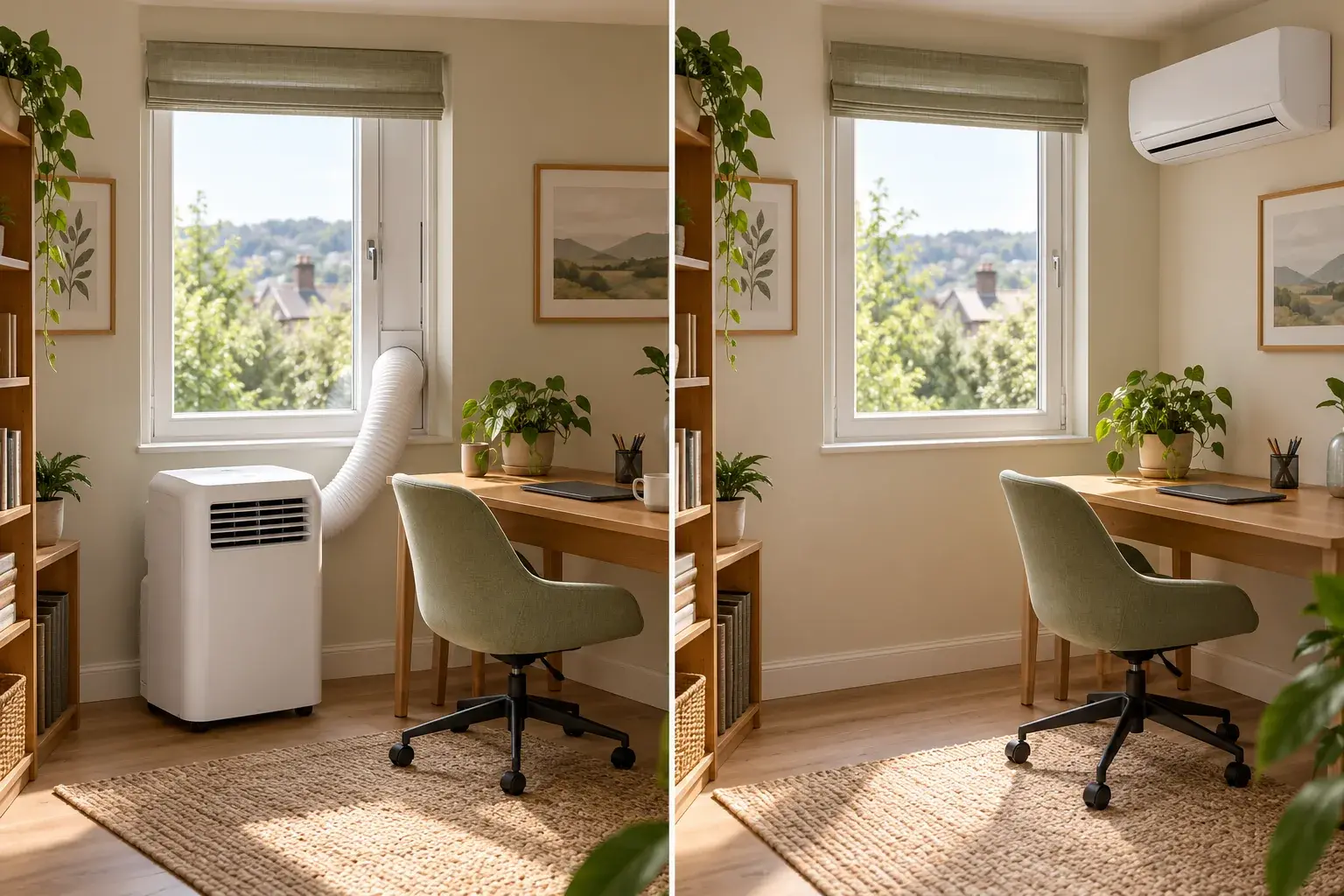
A portable air conditioner can be a sensible choice for occasional cooling or a temporary home. A fixed split system is worth considering when noise, repeated setup or inadequate comfort makes the portable difficult to live with. Lower electricity use alone does not establish that an upgrade will pay for itself.
Start with the problem you want solved. “I need this office comfortable during calls” is a better installation brief than “I want something more powerful”.
The image is an AI-generated comparison of two design concepts, not a customer installation or a technical installation plan.
What changes when you choose a split system?
This comparison concerns a conventional portable unit with an exhaust hose and a professionally installed fixed split. Check the product type carefully: equipment marketed as a portable split is a different arrangement.
Daikin's comparison of installed and portable air conditioning explains the broad trade-off: a portable offers mobility and a lower initial outlay; a fixed system needs professional installation and more initial spending, with the compressor outdoors helping reduce indoor noise.
| Decision | Portable with an exhaust hose | Fixed split system |
|---|---|---|
| Moving home | Can move with you | A permanent installation; include your likely time in the property in the decision |
| Space inside | Floor position plus a route to an outside vent | Indoor appliance and pipe route, plus space outside for a separate unit |
| Daily convenience | Consider setting up the vent and storing the appliance | Consider controls, cleaning access and planned servicing |
| Main budget question | Does this particular unit meet the need? | Is the improvement worth the additional installed and ownership cost? |
A fixed installation still needs a suitable layout. It is not a promise that one indoor unit will cool every closed bedroom.
Before replacing a portable, check its setup
A poor setup can make a useful appliance look unsuitable. De'Longhi's venting instructions say exhaust air must go outside through a suitable window or wall arrangement. Sending the hose into the landing simply moves unwanted heat elsewhere indoors.
Using your model's manual, check:
- The window kit fits the opening and seals around the exhaust route.
- The hose follows the permitted length and routing; it has not been extended to reach a more convenient corner.
- Filters and air openings are clean and unobstructed.
- The room is within the model's intended cooling capability, including its glazing and sun exposure.
- Drainage is being managed as instructed. Some units evaporate moisture through the exhaust, but may still need draining in humid conditions.
These checks reflect Honeywell's portable-air-conditioner guidance; the instructions for your own appliance take priority. Do not modify refrigerant components or bypass a warning to keep it running.
If correcting the setup gives you acceptable comfort, keeping the portable may be the right decision. If it still fails your everyday needs, take those observations into a survey.
Use this upgrade worksheet
For a few representative warm days, note when you use the room, what the portable achieves and what remains frustrating. You are gathering a practical brief, not carrying out a laboratory efficiency test.
| What you notice | Evidence to collect | What a fixed-system proposal should answer |
|---|---|---|
| You switch cooling off during calls or sleep | Which sounds bother you, and at which operating setting? | What are the proposed unit's sound figures at the settings needed for this room? |
| The hose arrangement is inconvenient | Photos of the window, kit and usable floor space | What permanent pipework, drainage and visible trunking would replace it? |
| The room remains uncomfortable | Room dimensions, glazing, sun exposure, hours used and current unit model | What cooling load has been assessed, and what comfort is the design intended to deliver? |
| You move one unit between rooms | Which rooms need cooling at the same time? | Is the quote for those rooms, or only one of them? |
| You expect to move soon | Your likely period of use | Is the benefit during that period worth the extra commitment? |
Ask for comparable noise specifications. Daikin's sound guide distinguishes sound power, which describes the source, from sound pressure, which depends on the measurement position. Comparing the two as if they were identical can produce a misleading advantage. Ask about outdoor sound and any condensate pump too.
Compare the extra cost without assuming a payback
Use actual quotations and your tariff. Separate the purchase decision from an electricity calculation:
- Additional initial spending: fitted-system quote minus the spending you would otherwise make on a portable. If you already own a working portable, its original purchase price is not a new saving from upgrading.
- Electricity difference: compare estimated consumption for the same room, comfort target and hours of use. Cooling output in kW is not the same as electrical input in kW.
- Other ownership costs: include the proposed maintenance arrangements and any costs missing from the installation quote.
Illustrative arithmetic only: suppose the estimated average electrical input difference were 0.4 kW, over 300 cooling hours a year, at an assumed £0.25/kWh. That would be 0.4 × 300 × £0.25 = £30 a year in electricity. These are invented calculation inputs, not measured equipment performance, a current tariff or a savings forecast.
Even a real electricity saving of that size would not, by itself, justify a large installation bill. You might still choose the upgrade for quieter working or easier daily use. Equally, using the new system for longer because it is convenient could reduce or remove the expected bill saving.
Ask the installer to show the assumptions behind any annual-cost estimate. Our air-conditioning installation cost guide explains what the quote should include.
Check that fixed installation is feasible in Wales
Before buying equipment, settle the outdoor location, pipe and drainage routes, electrical work and any permissions. See our outdoor-unit placement guide for that separate layout decision.
For a Welsh property, use Welsh Government's domestic heat-pump planning guidance, updated for the rules introduced on 1 June 2026. Its permitted-development route is conditional and covers heating or heating-and-cooling equipment, rather than cooling-only units. Ask how your specific proposal meets the conditions; do not assume guidance for England applies. Tenants and leaseholders should also resolve the relevant property permissions before agreeing alterations.
Installation of systems containing F-gas requires the appropriate qualifications under GOV.UK guidance. A fixed split is not a plug-in replacement for a portable.
Turn your comparison into a useful enquiry
Send your current appliance model, room photos and the completed worksheet with your enquiry. State the two improvements that matter most and ask the proposal to address them explicitly. This keeps the discussion focused on a useful outcome rather than a more expensive box.
Smart Space Living offers air-conditioning installation across its South Wales service areas. Request a quote with those details to explore whether a fixed system fits your room and priorities.