How Often Should Home Air Conditioning Be Serviced?
For most home split air-conditioning systems, plan a professional service once a year. Treat that as a practical baseline, then check the selected manufacturer's instructions, warranty terms and the amount of work the system actually does. A bedroom unit used for a few hot weeks and a multi-split system heating through winter do not have identical workloads.
Filter care happens more often than the professional visit. It is also a different job: cleaning an accessible filter does not replace checks on coils, drainage, electrics, airflow and the refrigerant circuit.
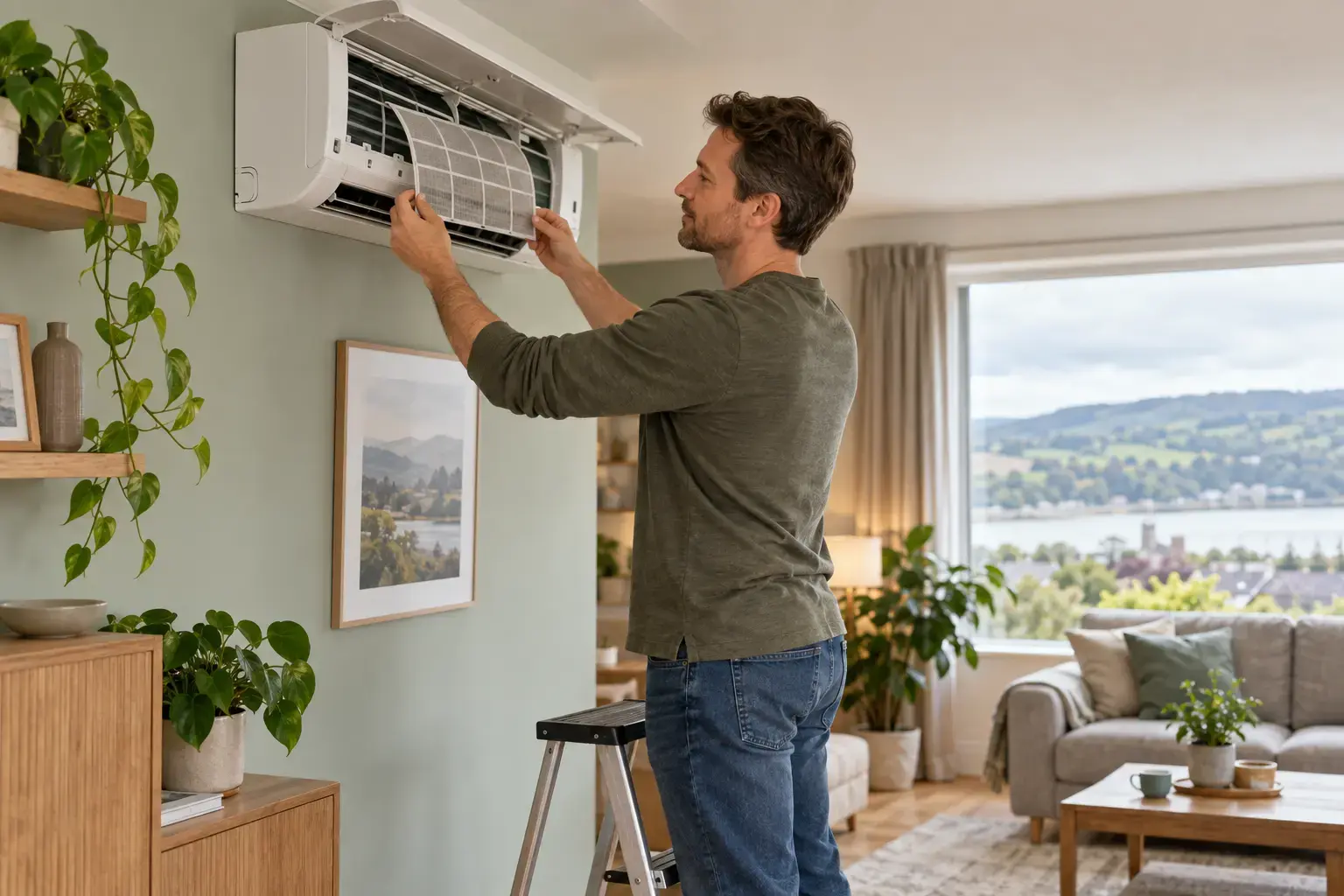
The image above is an AI-generated editorial illustration, not a completed customer job or a substitute for the instructions supplied with your unit.
Why annual servicing is a useful starting point
Daikin's current UK air-conditioner maintenance guidance recommends professional inspection at least once a year. Its separate guidance for air-to-air heat pumps—the same reversible technology used by many home split systems—also recommends annual servicing alongside routine cleaning.
One year is not a magic failure deadline. It is a sensible opportunity to find gradual changes before another season of heavy cooling or heating. Your exact schedule should come from:
- the maintenance section of the model's manual;
- the written warranty conditions, rather than a generic online claim;
- whether the system cools only or also provides regular winter heating;
- the number of indoor units connected to the outdoor unit; and
- environmental conditions such as dust, pet hair, pollen, vegetation or direct coastal exposure.
If the manufacturer or installer specifies a shorter interval, follow that. Keep the service record because a verbal promise that maintenance “protects the warranty” is not the same as reading the actual warranty terms.
Servicing, cleaning and repairs are different
These tasks are often grouped together, but they solve different problems.
| Task | Purpose | Typical trigger |
|---|---|---|
| Homeowner filter and visual checks | Keep accessible airflow paths clear and spot obvious changes | The model manual and how heavily the system is used |
| Planned professional service | Inspect, clean and test the system before faults are obvious | Normally annual for a domestic split system, subject to manufacturer guidance |
| Fault diagnosis or repair | Investigate a specific symptom or error | As soon as performance, sound, smell, drainage or safety changes |
| Statutory F-gas leak check | Meet a legal duty for equipment above the relevant refrigerant threshold | Depends on refrigerant type, charge and system design—not simply the calendar |
An annual service recommendation does not mean every small home system is legally required to have an annual F-gas leak check. UK Government leak-check guidance bases the legal intervals on the quantity and type of F-gas in the equipment, with specific treatment for some hermetically sealed systems.
Do not try to calculate the duty from the unit's cooling capacity alone. Ask the installer to identify the refrigerant, factory charge, any additional charge and whether a statutory check applies.
What you can safely do between services
The owner's manual takes priority because filter designs, access and cleaning methods vary. For a typical wall-mounted unit with accessible washable filters, the routine may include:
- Switch the system off as instructed before opening the front panel.
- Remove only the filters the user manual identifies as homeowner-accessible.
- Vacuum or wash them using the method allowed for that model.
- Let washable filters dry fully in the way the manufacturer specifies before refitting them.
- Wipe the closed outer casing with a suitable soft cloth.
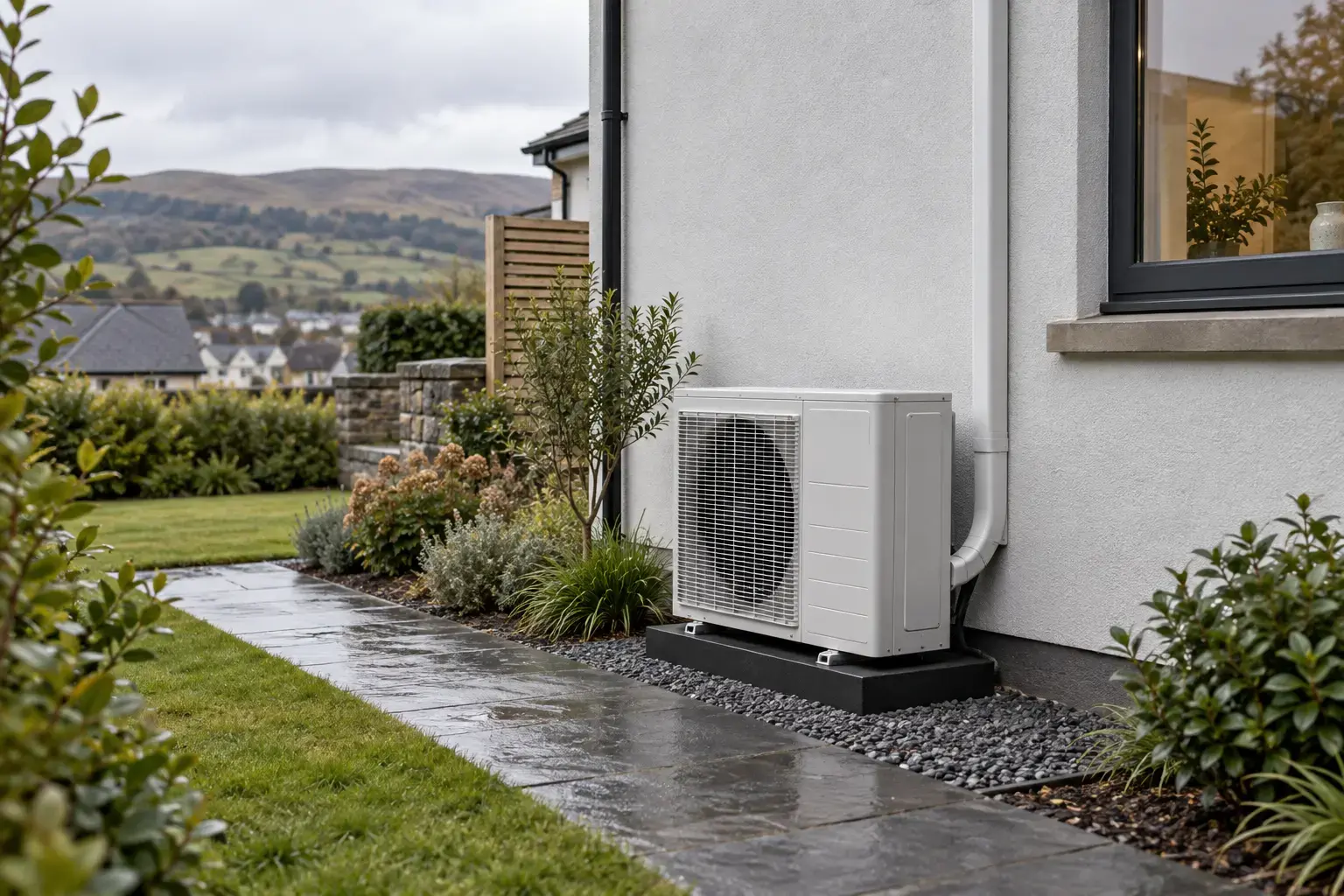
- Keep the outdoor unit's surrounding airflow space free from loose leaves, stored items and overgrown plants without removing its panels.
- Note any new noise, smell, water, icing, error code or reduction in airflow.
Do not spray chemicals or a pressure washer into either unit, straighten coil fins with improvised tools, open electrical covers or add refrigerant. Work involving an F-gas refrigerant system belongs with appropriately qualified personnel; current UK Government qualification guidance explicitly covers servicing, maintenance and leak checking.
What should a professional service cover?
The exact checklist depends on the manufacturer and system, but a useful service record should say more than “unit cleaned”. Ask what was inspected and tested, including:
- indoor filters, heat exchanger, fan and airflow;
- condensate tray, drain route and any pump;
- outdoor coil, fan and unobstructed airflow;
- pipe insulation and visible refrigerant connections;
- electrical components and controls;
- heating and cooling operation where both modes are used;
- unusual noise, vibration, odour, icing or fault history; and
- any leak-check or refrigerant work that was required, including who carried it out.
A service is also the right time to revisit access. A unit hidden behind new furniture, dense planting or a decorative outdoor screen may now be harder to inspect than it was at installation. Our outdoor-unit placement guide explains why working space and airflow need to remain part of the design.
When to bring the visit forward
Do not wait for the anniversary date if the system changes. Arrange professional advice when you notice:
- water dripping from the indoor unit or staining around it;
- ice on pipework or the indoor coil;
- weaker airflow after the accessible filter has been checked;
- a persistent musty, burning or electrical smell;
- a new rattle, grinding sound or strong vibration;
- repeated error codes or unexpected shutdowns; or
- a clear loss of heating or cooling performance.
Stop using the system and follow its safety instructions if there is a burning smell, signs of electrical damage or water near electrical parts. Resetting the isolator repeatedly may hide a fault temporarily; it is not a diagnosis.
A practical annual maintenance calendar
Consider a South Wales home with three wall units on one multi-split system. The household cools bedrooms in summer and uses heating mode in a home office during winter. This is an illustrative planning example, not a customer maintenance plan.
| Point in the year | Homeowner action | Professional action |
|---|---|---|
| During regular use | Inspect accessible filters and clean them when the model manual says; note changes in sound, smell, airflow and drainage | Bring the visit forward if symptoms appear |
| Before the main cooling season | Test cooling mode early enough to spot a problem before the first hot spell; clear loose outdoor debris without opening the casing | Complete the annual service if this is the agreed service month |
| Before regular winter heating | Check that heating mode starts and delivers normally; confirm the outdoor area and condensate route remain clear | Investigate faults rather than waiting until the next scheduled service |
| At the annual visit | Provide model details, previous records and a list of symptoms | Inspect all three indoor units and the shared outdoor system, then issue a clear service record |
The important point is that one outdoor unit does not turn three indoor units into a one-item checklist. Each indoor unit has filters, airflow and drainage to consider, while the shared refrigeration system also needs inspection. If you are still choosing the arrangement, see our single-split versus multi-split guide.
Questions to settle before a new installation
Aftercare is easiest to plan before equipment is fixed high on a wall or above a difficult roof. Ask the installation quote to state:
- The exact indoor and outdoor model numbers.
- Which filters you can access and how the manual says to clean them.
- The recommended professional service interval.
- The written warranty's maintenance and record-keeping conditions.
- How the indoor drain and any condensate pump can be inspected.
- How an engineer will safely reach every service panel later.
- Who to contact if the system leaks water, shows a fault code or loses performance.
These questions complement the equipment, pipework, electrics and commissioning items in our air-conditioning installation quote guide. They help compare the lifetime practicality of two proposals, not just the installation-day price.
Smart Space Living installs fixed air conditioning across its South Wales service areas. Request an installation survey and quote, and ask for the recommended maintenance schedule and access plan for the exact system proposed.