Where Should a Carbon Monoxide Alarm Go With a Log Burner?
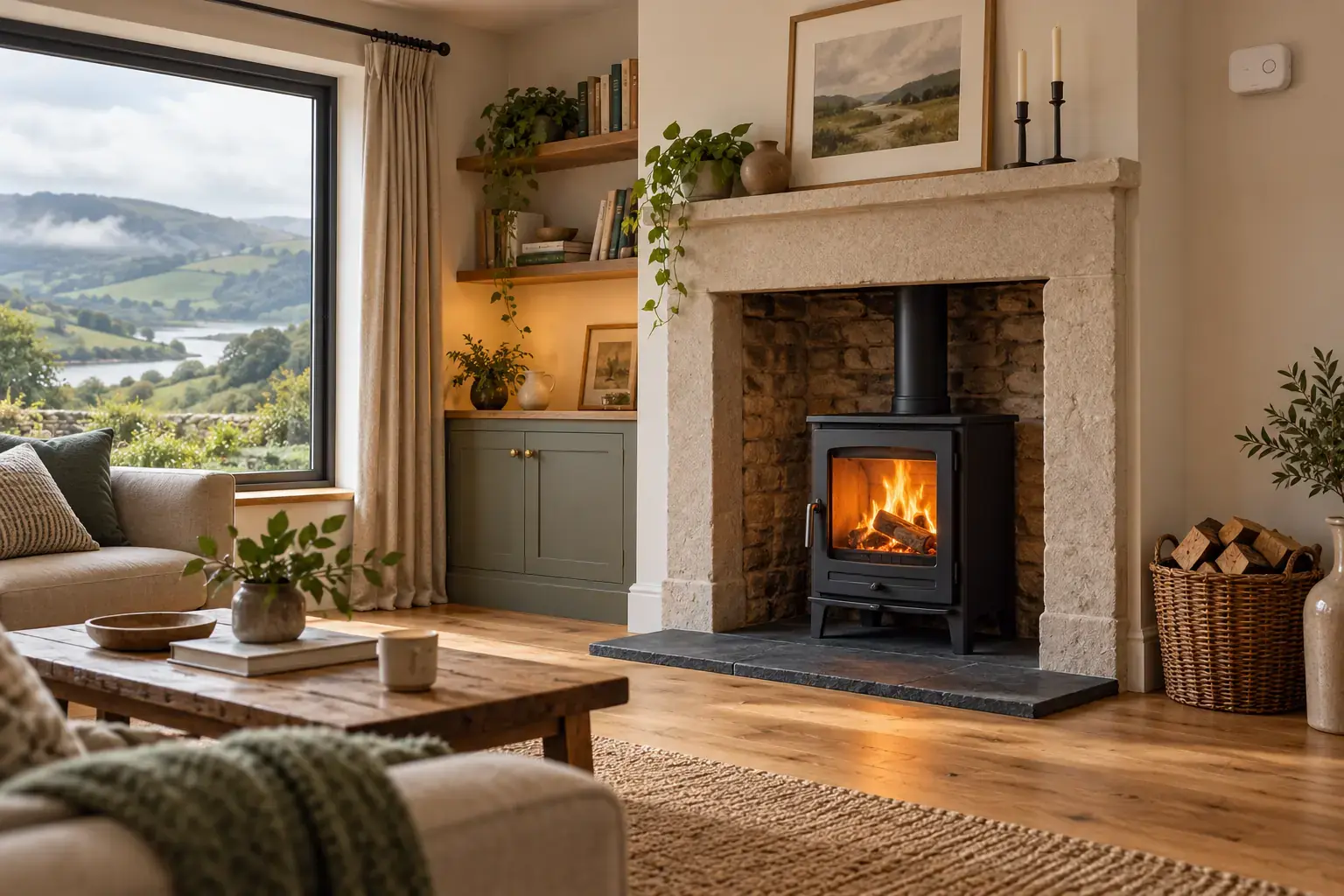
For a new or replacement log burner in a Welsh home, a carbon monoxide (CO) alarm should be provided in the space containing the stove. Unless the alarm manufacturer says otherwise, place it between 1 and 3 metres horizontally from the appliance, either on the ceiling at least 300 mm from a wall or high on a wall at least 150 mm below the ceiling and above any door or window.
Do not simply put it on the mantel, hide it behind furniture or fit it beside an air vent. The alarm model's instructions still matter, and the final position should be agreed as part of the installation.
The image above is an AI-generated editorial illustration, not a customer installation or a technical placement diagram.
What the current Welsh guidance requires
Wales has its own Approved Document J for combustion appliances. The current edition took effect on 6 January 2025 and added broader CO-alarm guidance for new or replacement fixed flued combustion appliances in dwellings.
For a log burner installation, the key points in paragraphs 1.24 to 1.30 of the Welsh Approved Document J PDF are:
- provide a CO alarm in every space containing a fixed combustion appliance;
- also provide one in a bedroom or principal habitable room where a flue serving a combustion appliance passes through that room;
- use an alarm complying with BS EN 50291-1:2018, with an integral sounder and a battery designed to last for the working life of the alarm, plus an end-of-life warning; and
- follow BS EN 50292:2023 and the alarm manufacturer's instructions for installation.
This is Welsh guidance. England publishes a separate Approved Document J, and rental-property duties are a separate legal question again. If you are a landlord or are dealing with an older existing installation rather than new building work, check the rules that apply to the property and tenure instead of treating a generic UK summary as definitive.
A practical placement checklist
Start with the manufacturer's instructions. If they do not specify a different arrangement, work through these four checks.
1. Keep it in the correct distance band
For the space containing the stove, the Welsh guidance gives a horizontal distance of 1 to 3 metres from the appliance. That means measuring across the room plan, not up the flue or diagonally through a wall.
Too close to the stove is not automatically better. Too far away—or in a different room with the door between—does not match the stated position for monitoring the appliance space.
2. Choose a compliant height
The detector should be either:
- ceiling-mounted, at least 300 mm from any wall; or
- wall-mounted, at least 150 mm below the ceiling and higher than any door or window in the room.
Those are alternatives, not instructions to fit two alarms. The selected alarm's installation manual may narrow the choice.
3. Remove obstructed and draughty spots
Approved Document J says a CO detector should not be placed:
- in a cupboard, behind a curtain or where furniture can obstruct it;
- directly above a sink;
- next to a door or window;
- next to an extractor fan, air vent or similar ventilation opening; or
- where temperatures may fall below -10°C or rise above 40°C, unless the detector is designed for those conditions.
In a typical living room, curtains, a tall display cabinet, shelving and the edge of an opening into another room can all rule out an otherwise convenient patch of wall.
4. Check that the alarm can be heard and maintained
The alarm needs to remain visible or otherwise accessible for the tests and replacement steps in its instructions. Record its installation or replace-by date, and make sure occupants recognise its alarm and end-of-life signals. A silent, expired unit is not made useful by being in the perfect position.
Worked example: choosing between three wall positions
Imagine a living room with the stove in a central chimney breast. A window and curtains are 1.2 metres to the left; the doorway is 2 metres to the right; an unobstructed return wall is 2.4 metres from the stove.
| Candidate position | Initial verdict | Reason to check |
|---|---|---|
| High on the wall beside the curtains | Reject | The curtain can obstruct the alarm and the window creates an excluded location nearby |
| High above the doorway | Reject | Wall mounting must be above the door height, but the guidance also says not to site the detector next to a door |
| High on the unobstructed return wall | Shortlist | It sits within the 1–3 m band and away from the obvious obstructions; confirm exact height and model instructions |
This exercise is deliberately a shortlist, not a remote installation sign-off. Room dimensions, openings, the alarm manual and any connected spaces still need checking on site.
Which CO alarm should you buy?
For an installation following the Welsh guidance, look for the product information that identifies compliance with BS EN 50291-1:2018. The document calls for an integral sounder, a working-life battery and an end-of-life warning.
It also permits a fixed-wired, mains-powered Type A alarm complying with the same standard where it includes a sensor-failure warning. A plug-in unit is not the fixed-wired option described in the guidance.
Do not choose an alarm solely because the packaging says “for stoves” or because it has a digital display. The relevant standard, power arrangement, lifespan and installation instructions are more useful checks. Keep the manual with the stove handover documents.
One alarm does not make an installation safe
The Welsh document is explicit that a CO alarm is not a substitute for correct appliance installation and regular servicing. The stove still needs a suitable flue, combustion air, hearth and clearances, followed by appropriate commissioning and notification.
For example, an alarm does not solve a blocked or leaking chimney. Our guide to whether a wood burner needs a chimney liner explains the inspection and testing decision, while the Wales air-vent guide covers combustion air and extractor-fan checks.
Ask the installer to show the CO alarm on the written scope rather than assuming somebody else will supply it. At handover, confirm:
- the alarm's make, model and stated standard;
- its exact distance and position relative to the stove;
- how to test it and recognise fault or end-of-life signals;
- the replacement date or expected working life; and
- that the alarm is included alongside the stove commissioning and compliance paperwork.
What should you do if the alarm sounds?
Treat an alarm as a real warning. Follow the alarm manufacturer's emergency instructions. If you can do so safely, stop using the suspected appliance, get everyone into fresh air and seek appropriate advice before going back inside or relighting the stove.
The NHS guidance on carbon monoxide poisoning says to go outside and get medical advice if you think you may have carbon monoxide poisoning. Call 999 or go to A&E for serious symptoms such as difficulty breathing, sudden confusion, loss of consciousness, weakness, or chest or muscle pain. Do not use the stove again until a competent person has identified and corrected the cause.
The survey-ready answer
Before your survey, sketch the room, mark a 1–3 metre band around the proposed stove and cross out doors, windows, curtains, vents, extract fans and furniture. Bring the shortlisted position and exact alarm instructions to the installer. That five-minute exercise exposes conflicts while the placement can still be changed neatly.
Smart Space Living installs wood-burning and multi-fuel stoves across its South Wales service areas. For a property-specific design and written scope, request a log burner survey and quote and ask for the proposed alarm position to be included.