Does a Wood Burner Need a Chimney Liner in Wales?
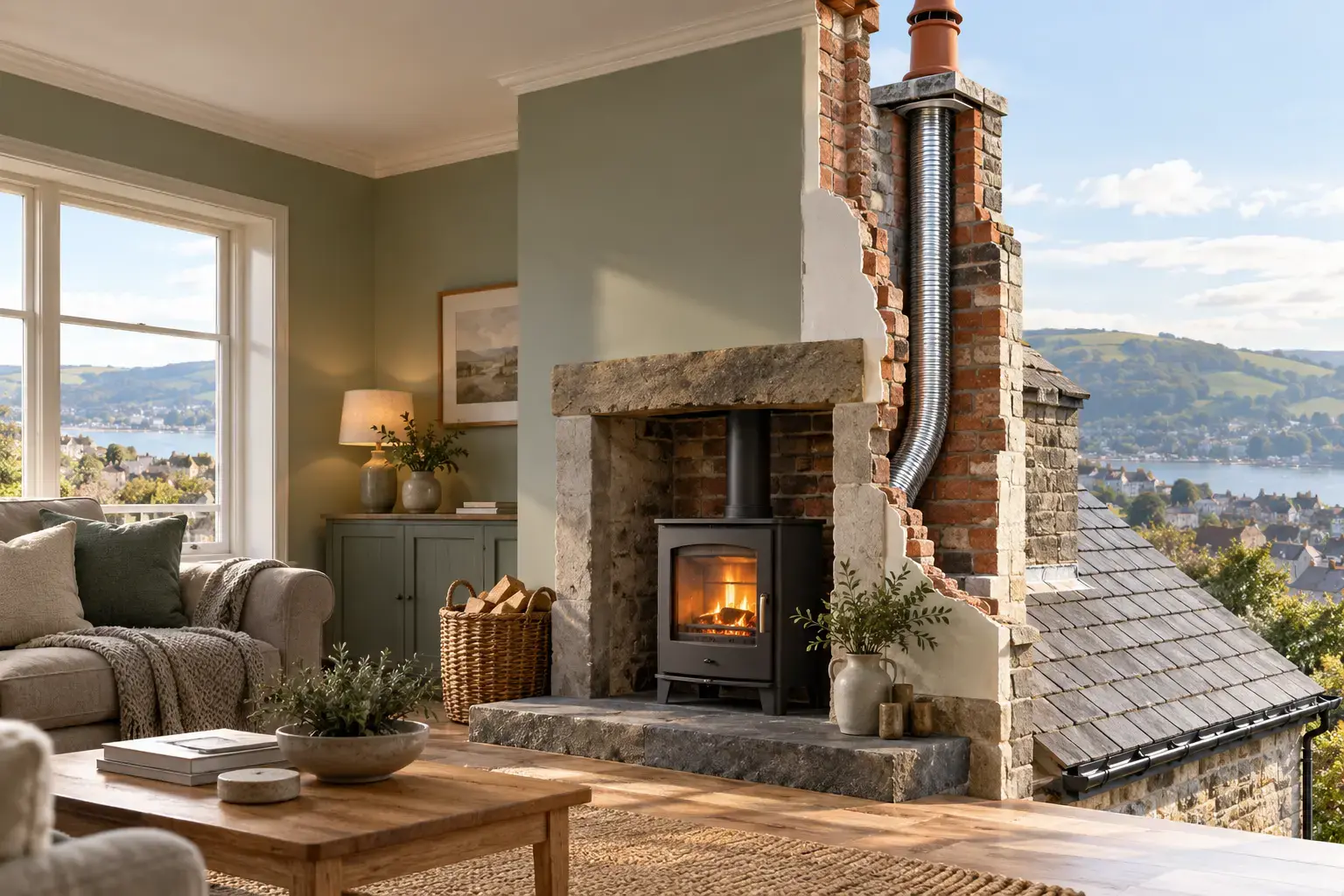
A wood burner does not automatically need a new flexible liner simply because it is being fitted into an existing chimney. The existing flue must first be checked for condition, size, obstruction and gas-tightness. If it is defective, unsuitable or too large for the chosen stove, relining may be the practical way to make it suitable.
That distinction matters. “There is a chimney” does not prove that the flue is ready to use, but neither should a liner be treated as an unexplained item added to every quote.
The image above is an AI-generated cutaway concept, not a customer installation or a technical construction drawing. The actual liner, connections and chimney details must be specified for the appliance and property.
Chimney, flue and liner: three different things
These terms are often mixed together:
- The chimney is the structure that contains and protects the route carrying combustion gases.
- The flue is the passage through which those gases travel.
- A flue liner forms or renews the inner surface of that passage.
In an older masonry chimney, the flue may be formed by clay liners, another lining system or older masonry. A flexible stainless-steel liner can be lowered through an existing chimney to reline that passage. It does not replace the chimney structure around it.
The current Welsh Approved Document J says flexible metal liners are for relining a chimney, not for use as the primary liner of a new chimney. A house with no chimney needs a different solution, usually a properly specified factory-made insulated system chimney; our guide to installing a log burner without a chimney explains that separate decision.
When might the existing flue be reused without a new liner?
The honest answer depends on evidence from the chimney, not its age or appearance in the room.
Welsh Government guidance says that a flue being brought back into use, or reused with a different appliance type or rating, should be checked and altered if necessary for the proposed use. A potentially reusable flue therefore needs to be:
- clear of soot, tar, nests, loose material and other restrictions;
- in suitable structural condition and acceptably gas-tight;
- correctly sized for the proposed stove;
- compatible with the fuel and expected flue-gas conditions; and
- arranged so it can be inspected, cleaned and safely connected.
A decorative fireplace that looks sound from below tells you very little about hidden joints, old lining, changes in the roof space or the exposed chimney above the roof.
What should the chimney check involve?
Appendix E of the Welsh Approved Document J PDF gives a practical sequence for checking an existing flue before reuse:
- Sweep it first. This removes deposits and obstructions, improves visibility and can reveal pieces of liner or brick that suggest deterioration.
- Inspect accessible parts. The check should look for damaged structure or lining, incompatible alterations, smoke or tar staining, and whether the lining and size suit the new use.
- Check for restrictions. A visual check may be enough where the full route can be seen; in doubtful cases a suitable obstruction check may be required.
- Check gas-tightness. The guidance identifies a smoke test as a way to assess the flue.
- Test the complete installation. Once the stove is connected, the appliance and flue system need commissioning checks appropriate to the installation.
This is not a do-it-yourself smoke-pellet exercise. Choosing the right test, protecting the property, interpreting the result and commissioning the finished system require competent judgement.
When does relining become likely?
The survey may point towards a liner for more than one reason.
| Finding | Why it matters | Likely next question |
|---|---|---|
| Cracks, leakage or deteriorated lining | Combustion gases must be carried safely to the outside | Can an appropriate relining system make the flue suitable, or is repair also needed? |
| Flue is too large for the selected stove | Welsh guidance notes that an oversized flue can be unsafe | What diameter and performance designation does the stove and flue design require? |
| Heavy tar, staining or damaged masonry | Deposits may hide defects; staining can indicate leakage | What must be cleaned or repaired before any liner is installed? |
| Old metal liner already present | Its age, condition and suitability may be uncertain | Can it be proved recent and seen to be in good condition? |
| Route is blocked or altered | Safe connection, cleaning and draught may be compromised | Can the obstruction be removed and the full route verified? |
Approved Document J says an existing metal liner should be replaced when the appliance is replaced unless the liner can be shown to be recently installed and seen to be in good condition. That makes “there is already a liner” a starting fact, not proof that it can remain.
A worked example: two similar fireplaces, different answers
Consider two 1950s houses, each with a chimney breast and an open fireplace being converted for a small wood burner.
In House A, sweeping produces normal deposits, the accessible chimney and lining appear sound, the route is clear, the size suits the proposed appliance and the required tests are satisfactory. The installer may be able to justify reusing the existing flue without adding a flexible liner.
In House B, sweeping brings down fragments, tar staining is visible in the loft and testing indicates leakage. A liner may form part of the remedial design, but it should not be used to disguise unresolved structural damage or left unexplained as a generic upgrade.
The rooms and stoves could look identical. The hidden flue evidence changes the scope, which is why an online yes-or-no answer cannot replace a chimney assessment.
Who chooses the liner specification?
The chosen liner has to suit the appliance, fuel and flue-gas characteristics and be installed to the relevant product instructions. Welsh guidance also sets performance criteria for solid-fuel flue components.
For a homeowner comparing quotes, the useful questions are not simply “Is it 316 or 904 stainless steel?” or “Is six inches better than five?” Those labels do not, by themselves, prove that the complete design suits the stove. Ask instead for:
- the exact stove make and model;
- the proposed liner manufacturer, product and diameter;
- its declared performance designation and suitability for the intended fuel;
- why the existing flue cannot be reused as it stands;
- any insulation or chimney repair included in the design;
- how the top and bottom connections, cleaning access and debris collection are handled; and
- the notification, commissioning and completion documents included.
The stove manufacturer's instructions may be more demanding than a generic minimum, so the appliance should be selected before the flue specification is finalised.
Is a new liner Building Regulations work in Wales?
Yes, a new or replacement flue liner can be notifiable building work in Wales. Approved Document J describes flues as controlled services and gives insertion of rigid or flexible prefabricated linings as an example of work requiring notification.
Ask the installer to state who will notify the work and what compliance documentation you will receive. Building Regulations are separate from planning permission, smoke-control rules and any listed-building consent. Our Wales log burner planning guide explains those separate checks.
This article uses the Welsh edition of Approved Document J, last updated on 6 January 2025. England publishes its own current guidance, so a project there should be checked against the English rules rather than assuming every detail is identical.
Chimney-liner quote checklist
Before accepting a quote, look for a written answer to each of these points:
- What was found when the existing chimney was swept and inspected?
- Which checks or tests support the conclusion that a liner is—or is not—needed?
- Does the quote include any chimney repair, or only the liner?
- What exact liner and diameter are proposed, and how do they match the stove?
- Is an old liner being removed, retained or replaced, and why?
- Are access, cleaning, top termination, connections and making good included?
- Who handles Building Regulations notification and commissioning?
- What is excluded, such as scaffolding, chimney-pot work or redecoration?
This also helps explain why liner length and chimney condition affect an installation quote. Two prices may cover materially different remedial work.
The practical answer
Do not assume that every existing chimney needs a flexible liner, and do not assume that an unlined chimney is automatically ready for a modern stove. The defensible decision comes after sweeping, inspection, suitability checks and any necessary testing against the proposed appliance.
For a property-specific assessment in South Wales, request a log burner survey and quote. Include photographs of the fireplace, chimney breast, chimney stack and any visible staining, plus details of any previous stove or liner paperwork.