Can You Store Logs Next to or Under a Log Burner?
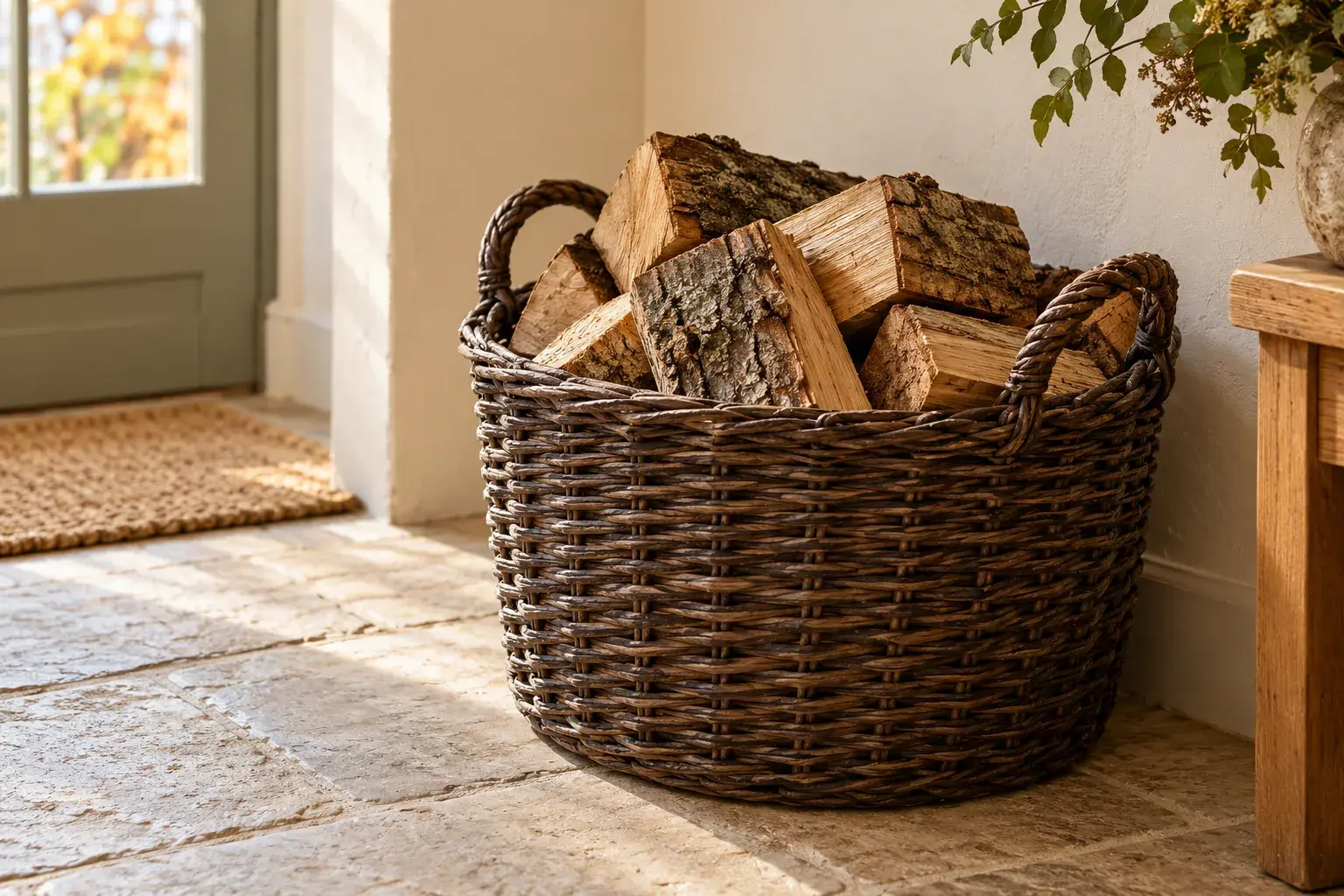
Do not stack logs against a stove or use its hearth as a handy fuel shelf. Under-stove storage is only an option where the manufacturer expressly permits it for that exact model and configuration. An empty space beneath a stove, or a photograph showing logs there, is not enough to establish that it is a usable log store.
If you are planning a new fireplace, decide where the fuel will live before approving the design. A layout needs room for the stove, its protected surroundings and everyday storage—not just enough width to fit the appliance.
The image is an AI-generated editorial concept, not a customer installation or a demonstration of safe stove clearances.
A basket beside the fireplace is not automatically safe
Cheshire Fire and Rescue Service's wood-burning stove advice warns against keeping logs and other combustible materials close to a stove. That is fire-safety advice, not a statement of Welsh building regulations.
Treat the wood itself as combustible, even if its holder is metal. Replacing a wicker basket with a steel rack does not remove the fuel from the safety assessment. Nor does a stone floor make a pile of logs beside the stove acceptable.
There is no single basket-to-stove distance given here. Ask the installer to establish a storage position using the appliance and flue instructions and the actual room layout. Do not turn a generic distance found online into permission to pack the surrounding recess with fuel.
Our hearth guide for Welsh homes covers the protected floor area. Its edge is not a universal line beyond which all furnishings or fuel stores become safe.
What about a stove with a built-in log store?
The important distinction is between a documented storage compartment and an ordinary gap beneath or beside the appliance.
A useful manufacturer example is the Woodwarm Fireview Eco freestanding range manual. On printed page 20, it prohibits fuel on, under or near the lit appliance, then makes a specific exception for a modest amount beneath the log-store version. That exception requires both the dedicated log-store shield and the base heat-shield assembly to remain fitted.
This is not permission for another stove, a standard-height version or a homemade stand. It shows why the exact version and its components matter. Ask for the current instructions applicable to the appliance you are buying, including any separate stand instructions. If the intended use is unclear, obtain manufacturer confirmation before putting fuel there.
Use these questions when comparing designs:
| Proposed storage | What needs establishing before you choose it? |
|---|---|
| Separate basket or rack | A suitable position away from the appliance and hearth, assessed with the fuel loaded—not only the empty holder |
| Manufacturer's integral store | Explicit permission for that model, required components and any restrictions on loading or contents |
| Gap beneath a stove on legs | Do not assume it is storage; identify its intended purpose from the instructions |
| Bespoke alcove or recess beside the fireplace | Have its position and construction assessed with the proposed fuel inside; decorative masonry alone is not approval |
Do not improvise shielding or alter a stove's stand to create storage. Those are not interior-styling changes.
Draw the loaded stack, not just the basket
A useful planning exercise is to give the surveyor two outlines: the holder itself and the space occupied when it contains your usual logs. Include handles and any pieces that would project beyond its sides or top.
This matters because a drawing of an empty basket can conceal how it will actually be used. A narrow rack also offers little practical benefit if the only way to carry logs to it is through the stove's working space.
Ask the surveyor to check the proposal alongside:
- The appliance, hearth and flue arrangement.
- Door opening, refuelling and cleaning access.
- Any ventilation openings that must remain clear.
- The route through the room when carrying fuel.
- Where kindling, firelighters and packaging will be kept separately from heat.
Do not use the stove or hearth to dry damp logs. Plan suitable fuel storage independently of the appliance rather than relying on a hot surface to prepare the next load.
An example: decorative recess or separate basket?
Illustrative design decision, not a customer job: a homeowner wants matching stacks of logs on either side of a stove within an existing fireplace opening. The drawing looks balanced, but the proposed stacks have not been checked against the appliance instructions.
The next step is not to choose smaller logs or add a metal liner to the recesses. It is to leave those spaces unallocated until the installer has assessed them. Ask for a second layout with a separate basket elsewhere in the room, outside the stove's working and protected areas.
If an integral store is important, compare a suitable documented log-store model as a third option. Check the complete appliance dimensions and installation requirements again; a different base can change the overall layout. Do not choose the heat output simply to obtain a preferred storage shape.
The result may be less symmetrical, but it answers a more useful question: where can this household actually keep and collect fuel without compromising the installation?
Put storage on the survey brief
Before ordering a stove, basket or bespoke surround, send:
- A photograph of the whole fireplace wall and the nearby floor space.
- The exact stove model, including any stand or log-store option.
- A sketch of your preferred storage position and an alternative.
- The holder's dimensions and a photograph showing how you expect to load it.
- A request for the permitted storage location and any integral-store restrictions to be explained at handover.
Keep that information with the appliance manual so everyone using the stove follows the same arrangement. Do not let an agreed small store gradually spread onto the hearth.
If you are still choosing the appliance format, our inset versus freestanding stove comparison explains the wider fireplace-space trade-offs. Storage is one part of that decision, not a substitute for checking suitability and heat output.
Smart Space Living offers log burner installation across its South Wales service areas. Request a survey and quote, including your fuel-storage idea alongside the stove and hearth. It is easier to reconsider a basket or recess on a drawing than after the fireplace has been finished.