What Size TV Is Best for a Media Wall?
The best TV size for a media wall is the one that is comfortable from your usual seat, fits the wall by its actual outside dimensions and leaves the design usable when the TV is replaced. Do not choose from the advertised diagonal alone.
A useful order is: shortlist by viewing distance, compare the exact model widths, then mark both options on the wall. Only after that should the fire, soundbar, shelving and cabinet lines be finalised around the screen.
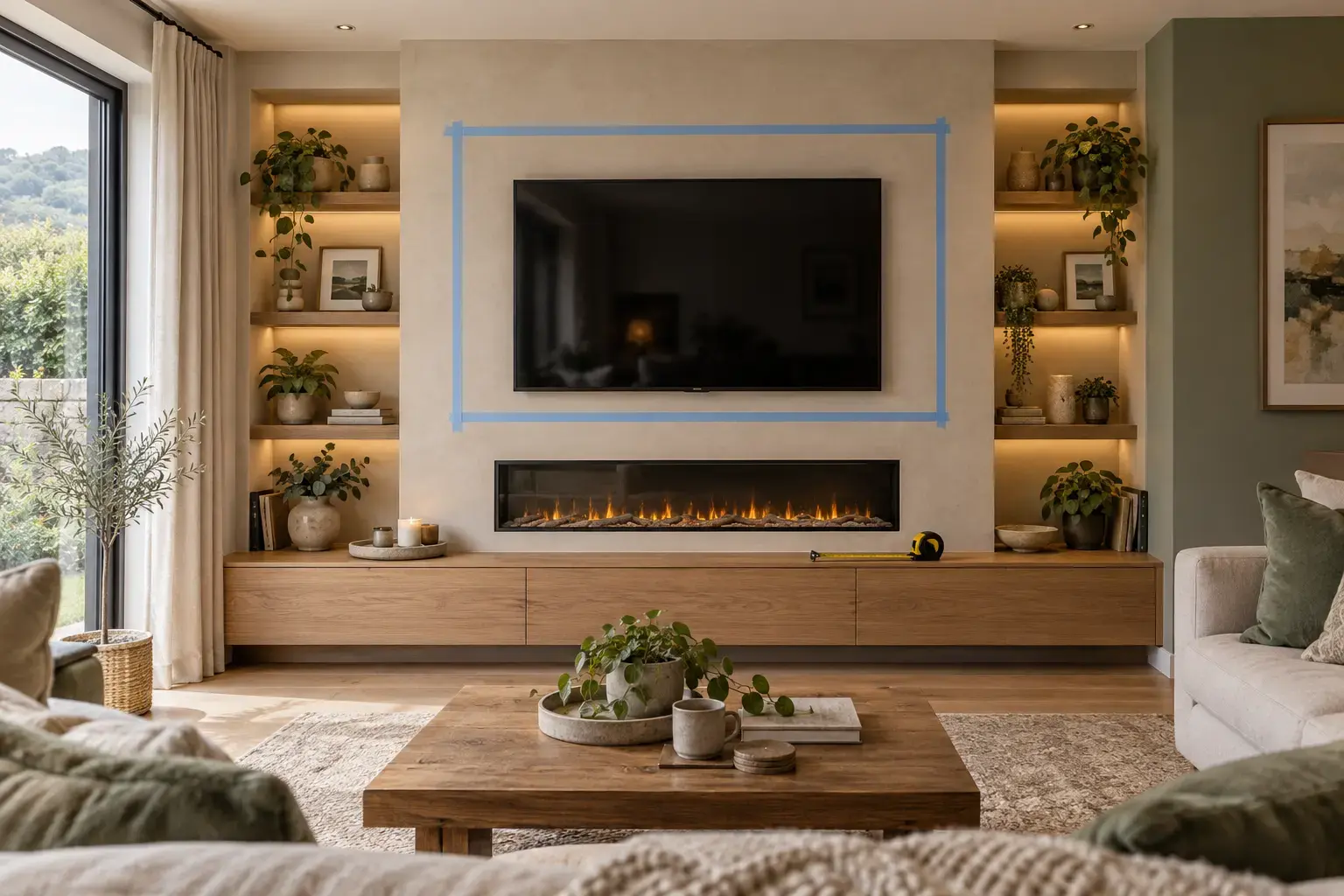
The image above is an AI-generated planning illustration, not a photograph of a completed customer installation.
Start with viewing distance, not wall width
Measure horizontally from your normal eye position on the sofa to the proposed screen face. If the media wall will project farther into the room than your current wall, allow for that change.
Manufacturer recommendations are useful starting points, not a substitute for testing. Samsung's UK TV size guide suggests multiplying a 4K screen's diagonal by 1.2 for an approximate viewing distance. On that basis, a 65-inch screen starts around 78 inches, or roughly 2 metres, away. Your eyesight, the content you watch and whether you prefer an immersive or restrained picture can still change the choice.
Shortlist two neighbouring sizes rather than treating a formula as a verdict. Mark both rectangles, sit in every regular seat and watch a familiar programme on a similarly sized screen if you can. Also check off-centre seats: a layout that looks balanced from the doorway may feel different from the end of an L-shaped sofa.
This article chooses the screen's size. Use our separate media wall TV height guide to position its centre at a comfortable level.
A 65-inch TV is not 65 inches wide
TV sizes are measured diagonally across the visible screen. They do not state the casing width, height, bezel, connection position or bracket pattern. Those details vary by model and are what the media-wall drawing needs.
For a 16:9 screen, the visible picture width is approximately 87.2% of the diagonal. This makes a useful early comparison:
| Advertised diagonal | Approximate visible picture width | Use for the final design? |
|---|---|---|
| 55 inches | 48.0 in / 121.8 cm | No — confirm the chosen model's overall width |
| 65 inches | 56.7 in / 144.0 cm | No — confirm the chosen model's overall width |
| 75 inches | 65.4 in / 166.0 cm | No — confirm the chosen model's overall width |
The figures are geometry for a 16:9 picture area, rounded to one decimal place. They are not product dimensions and do not include the bezel. Before the build is approved, use the manufacturer's specification for the exact model without its stand.
Decide how much wall should remain around the TV
There is no universal rule saying the TV must be a fixed percentage of the media wall or a particular size relative to the fire. Those are design preferences, not safety standards.
Instead, draw the elevation with real dimensions and ask what the remaining space must do:
- Does each side need to contain a shelf, speaker or cabinet door?
- Will the TV look cramped against a return, chimney breast or tall unit?
- Does an off-centre doorway make perfect symmetry less important?
- Will curtains, radiators or existing sockets restrict the usable wall span?
- If a soundbar is planned, is there enough width and clear space for its actual model?
A larger screen may be comfortable to watch yet leave too little room for the storage brief. That does not necessarily mean choosing a smaller TV; it may mean simplifying the surrounding joinery or using a narrower central feature.
For the floor-space decision, see how deep a media wall needs to be. Width and projection should be considered together rather than in separate sketches.
If there is a fire, check products before fixing proportions
Do not size the TV from a generic “TV-to-fire ratio”. Select the electric fire and TV, then check both sets of installation instructions. Required openings, clearances, ventilation and positions are product-specific.
The fire can be wider, similar in width or visually separate from the screen if the approved layout allows it. The important points are that the arrangement complies with the selected products' instructions, the TV remains comfortable to watch and the finished composition works in the room. Our electric fire media wall guide covers that decision in more detail.
If the only way to fit a larger TV is to push it higher above the fire, return to the seated-height test. A bigger diagonal is a poor trade if it creates an uncomfortable viewing position.
Use this two-size worksheet
Suppose a homeowner is comparing a 65-inch and a 75-inch TV. The media wall will be designed after the exact models are chosen. This is an illustrative planning exercise, not a specification.
| Check | Candidate A | Candidate B |
|---|---|---|
| Advertised size | 65 inches | 75 inches |
| Exact casing width from product specification | ______ | ______ |
| Exact casing height without stand | ______ | ______ |
| Distance from main seat to proposed screen face | ______ | ______ |
| Clear wall left at each side on the drawing | ______ | ______ |
| Desired screen centre still achievable | Yes / No | Yes / No |
| Fire and soundbar instructions checked | Yes / No | Yes / No |
| TV removable without damaging finish | Yes / No | Yes / No |
| Ports and cables accessible | Yes / No | Yes / No |
Tape both outside dimensions onto the wall using a surface-safe method tested in an inconspicuous place. Photograph each outline from the main seat, a secondary seat and the doorway. Keep the sofa, coffee table and lamps in their normal positions so you judge the real room rather than an empty shell.
Reject an option if it fails a practical check. The winning size is not simply the largest rectangle that can be squeezed between two shelves.
Plan for a replacement without building a universal recess
A close-fitting TV recess can look neat, but it ties the finish to one product's dimensions and connection layout. Replacement sets with the same advertised diagonal can have different casings, mounting points, ports and ventilation instructions.
Discuss these options before construction:
- Mount the TV on the face of the media wall rather than enclosing it in a tight recess.
- Keep the bracket and connections serviceable so the screen can be removed normally.
- Agree a realistic larger replacement size and test that specific envelope on the drawing.
- Provide a cable route that can accept replacement leads without opening the finished wall.
- Avoid promising that every future TV will fit; recheck the next model before purchase.
Future-proofing is about preserving sensible access and tolerance, not guessing the dimensions of products that do not yet exist.
What to send for a useful media-wall quote
For a bespoke media wall installation, include:
- The clear wall width and ceiling height, plus photos showing both corners.
- The sofa-to-screen-face distance from each main seat.
- Exact TV model numbers, or two shortlisted models with their full dimensions.
- The proposed fire, soundbar, consoles and speakers.
- Which items may be upgraded and the larger outline you have tested.
- Any storage you consider essential.
Ask for the drawing or quote to identify the TV's overall width, screen centre height, removable access and the finished wall projection. Those four checks connect screen choice to the build rather than treating “65 inch” as a complete brief.
Smart Space Living installs media walls across South Wales. Request a design consultation and quote with your room photos and shortlist, and we can plan the feature around the way you actually watch television.