Can Air Conditioning Dry Mode Replace a Dehumidifier?
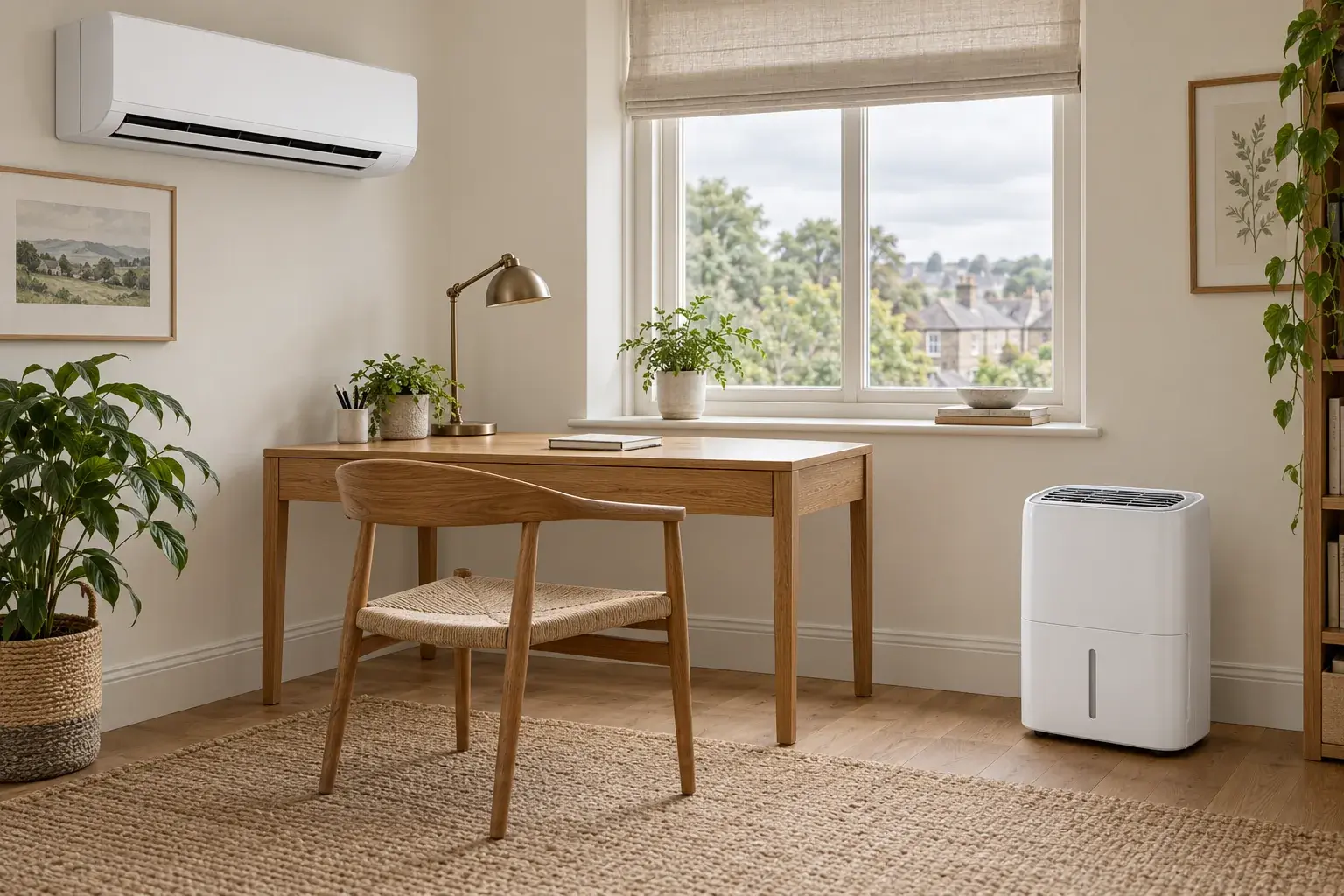
Dry mode can remove moisture from room air, but it is not an automatic replacement for a dedicated dehumidifier. It may suit a warm, clammy room where some cooling is welcome. If your main problem is moisture in an already chilly room, check the exact system's operating limits and consider a dehumidifier selected for those conditions instead.
For a South Wales home, the useful question is not simply “does it have a dry button?” It is “will it remove moisture in the room temperatures we actually have, without cooling us when we want warmth?” This guide concerns fixed split air conditioning, not a portable air conditioner with an exhaust hose.
Image: original AI-generated editorial concept, not a completed customer installation or a product recommendation.
Dry mode removes water by cooling air
Daikin's explanation of cooling and dry modes describes the basic process: room air passes through the indoor unit, moisture condenses as the air cools, and the collected water drains away. Cooling mode prioritises temperature; dry mode is intended to reduce humidity.
That does not mean dry mode guarantees unchanged room temperature. Nor does the label promise a particular humidity target, extraction rate or electricity saving. Those are separate specifications to check for the proposed equipment.
Start with the outcome you need:
| What you want | What to investigate |
|---|---|
| A hot room made cooler | Properly sized cooling, rather than choosing equipment from its dry-mode label |
| Less clamminess in a warm room | Whether the split system's dry mode works within that room's conditions and leaves it comfortable |
| Moisture removal without deliberately cooling a chilly room | A dedicated dehumidifier suitable for the actual temperature, alongside assessment of the moisture problem |
| A dependable target humidity | Whether the exact appliance senses humidity and lets you select a target—not just whether it has a drying symbol |
Check the operating range before relying on it in winter
The indoor temperature matters as well as the weather outside. A reversible unit being suitable for winter heating does not prove that its drying mode is suitable for a cold room.
For a concrete example, the Daikin CTXF20–35F5V1B operation manual, pages 7–8, specifies an indoor drying range of 18–32°C. It also says the user cannot adjust temperature or airflow rate in drying mode. Those are requirements for that documented series, not universal settings for every air conditioner.
An illustrative room at 15°C would therefore be outside that model's stated indoor drying range. Turning the remote to dry would not make it a suitable cold-room dehumidifier. The same room at a different temperature still needs the other operating conditions checked.
Ask for the manual covering the exact indoor/outdoor combination on your quote. Identify the drying limits separately from the heating limits, and check what the controls actually allow. Do not assume a similarly named product has identical behaviour.
How a dedicated dehumidifier differs
A dedicated dehumidifier is designed around moisture removal rather than summer cooling. Meaco's explanation of its dehumidifier technologies distinguishes compressor models, which condense moisture on a cold coil, from desiccant models, which use a moisture-absorbing material. Both return warmer air rather than providing air-conditioning-style room cooling.
Temperature still matters. Compressor extraction performance is affected by the conditions, and desiccant equipment may be worth considering for colder spaces. Compare the selected model's operating range and extraction performance at conditions close to your room—not just the largest litres-per-day figure on the box.
Also check its humidity controls, noise, tank-emptying arrangements and any permitted continuous drainage. A dedicated appliance is not automatically suitable just because it is called a dehumidifier.
Neither purchase should be treated as a substitute for investigating persistent damp or a suspected leak. If the reason for the moisture is unclear, get that assessed before spending on equipment. This comparison is about appliance suitability, not diagnosing a building defect.
Write a two-season brief for the same room
Imagine a home office that is too warm in summer but feels chilly and has recurring window condensation in winter. This is an illustrative buying exercise, not a customer case or measured performance test.
A single request for “air conditioning to sort the room out” hides two needs. Write them separately:
- Summer: control overheating while the room is occupied; assess whether dry mode would be useful during warm, humid spells.
- Winter: establish why condensation recurs and whether moisture-control equipment is needed at the room's usual temperature, without unwanted cooling.
Before the survey, keep a short record of room temperature, humidity readings if you have a meter, when the problem occurs and whether the room is being heated. Use the record to describe conditions—not as a diagnosis or proof that one appliance will solve them.
Then ask the installer to mark each requirement as covered by the proposed system, requires separate equipment/advice, or not yet established. This makes a comparison between proposals more useful than a list of modes on a remote control.
If winter heating is also important, our air conditioning versus electric heating guide covers that separate choice. Do not treat the ability to heat as confirmation of a combined heating-and-dehumidifying function; ask for explicit manufacturer documentation if that is promised.
What should an installation quote confirm?
For moisture control to be part of the brief, ask for:
- Exact model numbers and manuals, including the proposed indoor/outdoor pairing.
- Drying-mode operating conditions, especially the indoor temperature range.
- Available controls: a selectable humidity target, or simply an automatic dry programme?
- Expected temperature behaviour: is some cooling part of the process, and does that fit your intended use?
- A separate explanation of ventilation. Removing moisture is not the same as supplying outside air; see our fresh-air and air-conditioning guide.
- Clear exclusions: any damp investigation, ventilation work or separate dehumidifier should not disappear into a vague promise of “better air”.
Avoid choosing between appliances on an unqualified claim that dry mode is always cheaper. Compare costs only for equipment doing the job you need under comparable conditions. A low electricity figure is not useful if the room remains unsuitable for the mode or becomes uncomfortably cool.
Smart Space Living provides fixed air-conditioning installation across its South Wales service areas. If you need cooling, heating or both, request a survey and quote and describe any moisture concerns separately. That lets you establish what the proposed air conditioner can do—and what needs a different solution—before you commit.